Publications

Media Coverage & Quotes

The Print · 2026

How Bankers' Books Evidence Bill seeks to replace 135-yr-old law: The proposed changes & concerns

The Print quoted our counsel, Samarth Luthra, in its coverage of the proposed Bankers' Books Evidence Bill, 2026, which seeks to replace the 135-year-old Bankers' Books Evidence Act, 1891 with a framework better suited to modern digital banking records.

Full summary

The article explains the Bill's proposed expansion of "bankers' books" to include physical, electronic, digital, virtual and cloud-based records, along with provisions recognising electronically generated records and digital signatures. Samarth notes that the reforms could reduce procedural delays and technical objections surrounding banking records in litigation, while emphasising that safeguards relating to authenticity, audit trails, cybersecurity and evidentiary reliability will remain critical to the Bill's practical effectiveness.
MIT Sloan Management Review India · 2026

India's AI Governance System Has a Coordination Problem

MIT Sloan India featured comments from our counsel, Samarth Luthra, in its analysis of the coordination challenges emerging within India's AI governance framework, particularly as multiple regulators and public institutions assume overlapping responsibilities in addressing artificial intelligence.

Full summary

The article examines how fragmented institutional responsibilities can create regulatory gaps across issues such as accountability, safety, data governance, and technological standards. Samarth highlights that India's challenge is not merely the absence of a dedicated AI law, but the need for stronger coordination among existing authorities to ensure coherent and effective governance as AI adoption expands across sectors.

The coverage underscores that a well-defined institutional framework may prove more significant than isolated regulatory interventions in addressing rapidly evolving AI-related risks.

News Mantra · 2026

Delhi High Court Protects CAG AAOs, Recognises Prima Facie Right to Six SAS Attempts in Probation Period

A recent Delhi High Court interim order, reported by NewsMantra, provides protection to Assistant Audit Officers of the Comptroller and Auditor General of India in proceedings concerning opportunities to clear the Subordinate Accounts Service Examination during probation, with our counsel, Samarth Luthra, representing the petitioners.

Full summary

The coverage examines the service-law implications of departmental examinations during probation, including the consequences of limited examination opportunities, the operation of the Recruitment Rules, and the administrative obligation to conduct examinations as contemplated under the CAG's circulars. Samarth's submissions supported the petitioners' case that the applicable framework contemplated six examination opportunities, with the Court finding a prima facie case and continuing protection for eligible petitioners.

The order highlights the continuing questions surrounding probation-related service rights and the administrative consequences of failing to provide the examination opportunities contemplated under the governing framework.

NDTV · 2026

RBI Eases Investment Norms For NRIs: How Will It Impact Indian Economy

Our counsel, Samarth Luthra, was featured in NDTV's coverage of the Reserve Bank of India's overhaul of the FEMA framework governing NRI and OCI investments in India, effective June 13, 2026.

Full summary

The article examines the RBI's introduction of a single designated repatriable rupee account to handle investment, redemption, and repatriation, alongside a doubling of individual investment limits in listed companies from 5% to 10% and a widened investor base now covering all individuals resident outside India.

Samarth submits that mature economies compete not only on investment returns but on regulatory predictability, and that simplifying compliance and easing fund repatriation strengthens India's regulatory credibility with global investors. He further notes that the central question is not whether India can attract capital, but whether its legal framework can allocate that capital efficiently, adding that reduced compliance costs achieved without diluting oversight make Indian markets more globally competitive.

LawBeat · 2026

One Thing I Wish Law Students Knew: Your Relationship With Your Teachers Matters More Than You Think

Our counsel, Samarth Luthra, authored a column for LawBeat's Law School Corner, addressing an aspect of legal education that he believes is often underweighted: a student's relationship with their teachers.

Full summary

The piece argues that while grades, internships, moots and publications are visible and measurable markers of a student's progress, the bond built with a teacher through consistent attendance, engagement, sincerity and intellectual growth is less visible but carries disproportionate weight later in academic and professional life. Samarth notes that this becomes especially significant for students pursuing an LL.M. abroad, where a letter of recommendation can supply the context a transcript cannot, speaking in ways that grades alone cannot capture.

He further submits that teachers who have observed a student's habits of mind over time often become quiet sources of credibility, connecting former students to opportunities across the Bar, Bench, academia and industry. Samarth concludes that such relationships must be genuine and sustained rather than transactional, and that being remembered well by one's teacher may be among the most valuable investments a law student makes in their own professional formation.

Business Standard · 2026

Property Mutation: Buyers of land and houses should pay attention! Property registry is not enough, know why mutation is also important?

Business Standard quoted our counsel, Samarth Luthra, in an article explaining why property mutation carries legal significance equal to that of registration when acquiring land or a house.

Full summary

The article distinguishes the two processes as a matter of law. Registration effects a transfer of title through instruments such as a sale deed, whereas mutation is the administrative correction of municipal or revenue records for taxation and record-keeping purposes.

Samarth sets out the practical consequences of omitting mutation, including exposure to property tax disputes, government notices, utility connection issues, building permission complications, loan and compensation hurdles, and future title disputes arising from mismatched records. He clarifies that although mutation does not confer title, failure to effect it can subject even a registered owner to avoidable legal, financial, and administrative liability.

CNBC TV18 · 2026

An Indian passport proves much, but it does not prove everything

CNBC TV18 turned to our counsel, Samarth Luthra, for his analysis of the legal distinction between an Indian passport and proof of citizenship.

Full summary

The article discusses how a passport, while a significant government-issued document and strong evidence of nationality, does not constitute conclusive proof of citizenship, which remains a statutory status governed by the Constitution and the Citizenship Act, 1955.

Samarth explains the evidentiary value of passports, the significance of the recent MEA clarification, and the judicial position on citizenship documents. He further notes that citizenship cannot be inferred from travel documents alone, particularly in matters involving fraud, suppression, or questions of statutory eligibility.

Moneycontrol · 2026

Can a child raised by parents claim property rights if DNA shows no biological relationship?

Money Control quoted our counsel, Samarth Luthra, in an article examining the inheritance rights of a child later found, through a DNA test, to be biologically unrelated to the family that raised them.

Full summary

The article distinguishes biological parentage from legal status as the governing test for property and succession rights, and considers the legal consequences of informal caregiving arrangements undertaken without a formal adoption.

Samarth clarifies that succession rights turn on legal status rather than emotional or social recognition. He explains that a child validly adopted under law occupies substantially the same legal position as a biological child for purposes of intestate succession, whereas a child raised informally, without a valid adoption, acquires no automatic right of inheritance.

Lawctopus · 2026

From Courtrooms to LL.M Mentorship: Samarth Luthra on Law, Learning and Shared Knowledge

A Lawctopus feature profiles our counsel, Samarth Luthra, tracing his professional trajectory through legal practice, advanced legal education, and mentorship.

Full summary

The article traces his entry into the profession, shaped by early exposure to legal practice, formal legal training in Delhi, and an LL.M. in International Business Law from the London School of Economics. It canvasses his views on legal education, litigation strategy, public law, commercial disputes, State responsibility in sports-related matters, bail jurisprudence, due process, tribunal reform, service law, and mentorship for postgraduate law aspirants.

Samarth also discusses his engagement in matters involving national athletes, high-profile criminal litigation, and insolvency proceedings, alongside guidance for LL.M. applicants. The piece frames law as both a public responsibility and a continuing discipline, underscoring the importance of honest advocacy, institutional accountability, and structured mentorship in the development of legal careers.

The Print · 2026

Powers of tie-breaker judge in split-verdict case: SC to examine

Our counsel, Samarth Luthra, addressed The Print's coverage of the Supreme Court's reconsideration of a tie-breaker judge's jurisdiction in split-verdict criminal appeals under Section 392 of the CrPC.

Full summary

The article examines the legal implications of the Court's review of Sajjan Singh v. State of Madhya Pradesh, including concerns that a third judge could reopen issues on which the original two-judge bench had already recorded unanimous findings.

Samarth submits that while a referee judge must possess sufficient competence to appreciate the matter, that authority should not extend to disturbing unanimous findings recorded by the prior bench. He further notes the Court's expressed reservations regarding an expansive reading of tie-breaker jurisdiction and the need for doctrinal clarity on this procedural mechanism.

The larger bench's ruling is expected to settle questions of finality, fairness, and judicial discipline in criminal appellate proceedings.

The Core · 2026

SonaComstar's Rs 30,000-Cr Feud Shows Indian Business Families Can No Longer Ignore Succession Planning

When The Core examined the ₹30,000 crore succession dispute involving Sanjay Kapur, it turned to our counsel, Samarth Luthra, for perspective on its broader implications for Indian business families.

Full summary

The article demonstrates how family wealth now extends well beyond land, homes, factories, and shops to encompass shareholding, voting rights, promoter control, trusts, real estate, intellectual property, board positions, and lender or investor confidence. It examines why succession disputes increasingly escalate from private family disagreements into business-continuity risks and litigation, including oppression and mismanagement claims under the Companies Act.

Samarth highlights the growing complexity of succession planning in promoter-led enterprises and advocates structured transition plans, defined governance protocols, and early communication within business families. He explains that unclear succession structures can precipitate litigation, leadership uncertainty, erosion of market value, and creditor concern, rendering proactive estate planning essential to both corporate governance and investor protection.

National media coverage · 2026

Ravi Dahiya and Sharad Kumar get interim relief from CAT on their demand for regularisation of services

Our counsel, Samarth Luthra, was reported by the national media on the Central Administrative Tribunal's interim order granting protection to Olympic medallist Ravi Kumar Dahiya and Paralympic medallist Sharad Kumar in their plea for regularisation of ad hoc appointments with the Delhi government.

Full summary

The coverage examines the service-law implications for elite athletes accepting State roles, including protection against discontinuation, the risks attendant on relinquishing secure prior posts, and the broader question of how public-sector appointments for decorated sportspersons are administered and stabilised.

Samarth notes that the Tribunal found an arguable case, issued notice to the Delhi government, and granted interim protection until the next hearing on August 19, underscoring the continuing uncertainty surrounding administrative follow-through, job security, and the institutional treatment of athletes following major international achievements.

Also reported by News DrumMSNIBC24Rediff Sports

MediaNews4U · 2026

Beyond the Break: Legal Minds on What India's Ad Cap Verdict Really Means

The Print turned to our counsel, Samarth Luthra, for his analysis of the implications of the Delhi High Court's decision upholding TRAI's 12-minute advertising cap.

Full summary

The article examines the regulatory and legal dimensions of the ruling, including TRAI's statutory authority, the treatment of viewer experience as an element of quality of service, and the resulting limits on broadcasters' commercial freedom. Samarth observes that the ruling extends the scope of broadcast regulation beyond tariffs, interconnection, and technical quality, directly affecting advertising inventory, pricing, sponsorships, and prime-time monetisation.

His analysis further addresses the impact on news, regional, and free-to-air channels, advertiser strategy, the regulatory asymmetry between digital and traditional television, and prospective challenges founded on proportionality, statutory purpose, and consultation. The ruling carries significant weight for television's evolving business model, consumer protection, and the broader debate on harmonised media regulation.

Live Law · 2026

Before Passing Laws, India Must Forecast Court Burden: Starting With Tribunals

Our counsel, Samarth Luthra, argues in a Live Law feature for a Judicial Impact Assessment prior to the introduction of new laws, offences, forums, appellate mechanisms, or tribunal structures.

Full summary

The article examines the mounting burden on India's justice system, including rising court pendency, inadequate judicial infrastructure, ongoing tribunal reform, and the implications of proposed tribunal legislation following constitutional challenges to the Tribunal Reforms Act, 2021.

Samarth submits that legislative and executive action must account for the likely increase in caseload, judicial strength, staff, courtrooms, and overall institutional capacity before adding to the burden on the justice system. He further contends that responsible law-making requires infrastructure planning, and that poorly designed reforms can themselves generate prolonged litigation.

National media coverage · 2026

Olympic and Paralympic medallists move CAT seeking regularisation of Delhi govt jobs

Our counsel, Samarth Luthra, represented Olympic medallist Ravi Kumar Dahiya and Paralympian Sharad Kumar in proceedings before the Central Administrative Tribunal concerning the regularisation of their Delhi government appointments.

Full summary

The coverage examines the challenge to repeated ad hoc extensions in government sports posts despite years of regular administrative service, and considers the broader legal questions arising from prolonged ad hoc employment in public service.

Samarth's submissions addressed service regularisation, legitimate expectation flowing from the terms of appointment, continuity of benefits, and protection against termination. In Sharad Kumar's matter, he further pressed the need for disability accommodation under the Rights of Persons with Disabilities Act.

This matter carries significance for the treatment of internationally decorated athletes appointed to public roles, the legal limits of extended ad hoc employment, and the obligation of government authorities to ensure fair service conditions and reasonable workplace accommodation.

Also reported by Amar UjalaTimes of IndiaPTI NewsLive Hindustan

Business Standard · 2026

Long Co-habitation Does Not Grant Legal Ownership in Family Property

Our counsel, Samarth Luthra, was featured in Business Standard Hindi's explainer on a common misconception in Indian family property disputes: whether living in a family home for years automatically confers ownership rights.

Full summary

He explains that possession and ownership are legally distinct concepts, and that residing in a house long-term does not by itself establish title. He notes that legal ownership can only rest on grounds such as inheritance, partition, a gift deed, a will, relinquishment, a court order, or a valid family settlement, and clarifies that everyday documents like Aadhaar cards, electricity bills, or property tax receipts serve only administrative or KYC purposes and carry very limited evidentiary weight in ownership disputes.

Samarth submits that such documents can show only that a person was residing at or connected to a property, never that they hold title to it, and that they can never substitute for a sale deed, gift deed, or registered will. He further notes that even a newspaper notice disowning a family member does not legally exclude them from inheritance, and that in the absence of a valid will, succession law alone governs how a self-acquired or ancestral property devolves.

News Drum · 2026

CBI court grants bail to superintendent of posts before judicial remand period ends

Our counsel, Samarth Luthra, argued a bail plea before a CBI court on behalf of a superintendent of posts arrested for allegedly demanding and accepting a bribe from two junior employees in New Delhi.

Full summary

The CBI stated that it laid a trap upon receiving a complaint and apprehended the accused while he was allegedly accepting part payment of the bribe, following which he was remanded to judicial custody.

The defence submitted that the accused had earlier found the same employees, who subsequently became complainants, consuming alcohol during working hours, and further argued that the accused posed no flight risk while continued custody beyond two days would trigger automatic suspension from service.

The CBI court accepted these submissions and granted bail prior to the expiry of the judicial remand period; an outcome the article characterises as comparatively rare.

Articles & Legal Commentary

Bar & Bench · 2026

Money bill or constitutional shortcut? The Supreme Court Judges Bill and parliamentary integrity

Bar and Bench carried a column co-authored by our counsel, Samarth Luthra, examining whether the Supreme Court (Number of Judges) Amendment Bill, 2026 was correctly routed through Parliament as a money bill.

Full summary

The article distinguishes a money bill from ordinary legislation as a matter of law. A money bill strips the Rajya Sabha of its power to reject or amend a law, leaving it only non-binding recommendations, whereas ordinary legislation requires approval from both Houses.

Samarth sets out why the classification matters here: the Bill's financial consequences alone, he argues, cannot make it a money bill, since almost any government policy has financial implications. He clarifies that the real question is whether the law "deals with" increased expenditure under Article 110(1)(e), or merely "involves" expenditure under Article 117(3) — and that blurring this line would erase bicameral scrutiny of institutional laws.

Live Law · 2026

Regulation By Injunction: How Indian Courts Are Shaping India's AI Policy

LiveLaw carried an article co-authored by our counsel, Samarth Luthra, on how Indian courts are shaping AI policy through personality-rights litigation over deepfakes and voice cloning.

Full summary

The article distinguishes India's position as a regulatory mismatch rather than a vacuum. Existing law is dispersed across privacy, dignity, passing off and defamation, while the government's Guidelines rely on voluntary standards that carry no binding force.

Samarth sets out how courts, in cases like Anil Kapoor, Jackie Shroff and Arijit Singh, have extended personality rights to voice, likeness and gestures, with injunctions now creating takedown and disclosure obligations that function as de facto regulation. He clarifies that this judicial response, though necessary, remains celebrity-driven, and that India still needs statutory rules protecting every individual, not just those with the resources to seek urgent relief.

RGNUL Financial & Mercantile Law Review · 2022

To Extend or to Exclude? Liquidation Timeline's Interplay with Stay on Alienation of Assets

Samarth Luthra authored an article for the RGNUL Financial & Mercantile Law Review examining the interaction between the liquidation timeline prescribed under the Insolvency and Bankruptcy Code, 2016, and a stay on the alienation of assets.

Full summary

The article traces amendments to Regulation 44(1) of the IBBI (Liquidation Process) Regulations, 2016, which reduced the liquidator's timeline for completing liquidation from two years to one year, and considers whether an existing stay on the alienation of assets warrants extension or exclusion of that period.

Samarth examines the competing statutory objectives of time-bound resolution and the protection of stakeholder interests, and analyses how adjudicating authorities ought to reconcile procedural deadlines with orders restraining the disposal of assets during liquidation.

The Daily Guardian · 2022

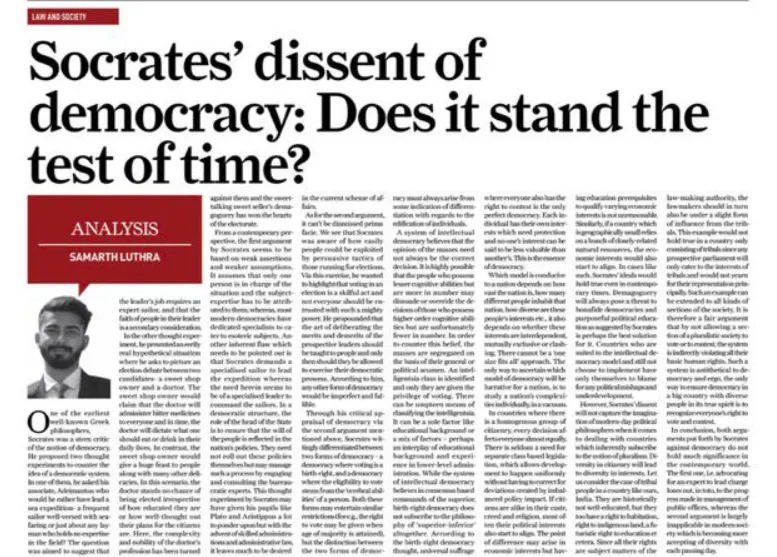
Socrates' Dissent of Democracy: Does It Stand the Test of Time?

Samarth Luthra authored a piece for The Daily Guardian revisiting Socrates' philosophical critique of democracy and its relevance to contemporary governance.

Full summary

The article examines Socrates' thought experiments questioning whether leadership ought to rest with the many or with those possessing relevant expertise, and considers the risk of demagoguery inherent in unqualified majoritarian rule.

Samarth contends that purposeful political education offers the most viable safeguard against demagoguery, while cautioning that Socrates' model sits uneasily with pluralistic societies such as India, where diverse and historically disadvantaged communities hold legitimate claims to political participation regardless of formal education.

NLUJ Law Review Blog · 2021

Weather Modifications and Law: Forecasting the Implication of Humankind's Reign over Rain

Samarth Luthra authored a piece for the NLUJ Law Review Blog examining the legal vacuum surrounding artificial weather modification, with particular focus on cloud seeding.

Full summary

The article traces the erosion of the Act of God defence in tort law as weather modification technology advances, and examines the cross-border implications of cloud seeding, drawing on China's Sky River project and its downstream effects on the Brahmaputra basin in India.

Samarth submits that existing international instruments, including the 1976 ENMOD Convention and the Draft Articles on Prevention of Transboundary Harm, fail to address non-hostile weather modification, and calls for a dedicated multilateral treaty followed by domestic legislation to govern the practice.

Bar & Bench · 2020

Hindsight 2020: Retrospective Analysis of the Public Health (Prevention, Control & Management of Epidemics, Bio-Terrorism and Disasters) Bill

Samarth Luthra, co-authoring with Satyam Singh, examined the Public Health (Prevention, Control and Management of Epidemics, Bio-Terrorism and Disasters) Bill, 2017 in a Bar & Bench article published during the early months of the COVID-19 pandemic.

Full summary

The article undertakes a retrospective analysis of the Bill's provisions against the backdrop of India's evolving public health emergency, highlighting gaps in the existing Epidemic Diseases Act, 1897, that the proposed legislation sought to address.

Samarth and his co-author identify specific provisions of the Bill bearing on epidemic containment, bio-terrorism preparedness, and disaster management, and consider their relevance to the legal and administrative response required during the pandemic.

LatestLaws.com

The Collegium System in India — History, Status Quo and Alternatives

Our counsel, Samarth Luthra, authored this piece for LatestLaws.com examining the evolution and functioning of India's judicial appointments framework. Drawing on the three landmark "Judges Cases," the paper traces how the Collegium System emerged despite the absence of any express constitutional provision for it.

Full summary

The piece evaluates the system's merits, chiefly judicial independence, against its criticisms, including concerns over nepotism flagged by the Law Commission and the absence of institutional accountability. It examines the 99th Constitutional Amendment's National Judicial Appointments Commission as a proposed alternative, and the Supreme Court's subsequent 4:1 ruling striking it down as unconstitutional on grounds of judicial independence and separation of powers, while also surveying comparable appointment mechanisms in the UK, South Africa, and Italy.

Samarth submits that the collegium's ongoing struggles with transparency and delayed appointments, including large-scale vacancies and friction between the judiciary and the Union government over pending recommendations, reveal a deeper accountability gap that neither the collegium's own practice nor the failed NJAC has resolved. He concludes that meaningful reform of judicial appointments in India remains an unresolved and urgent constitutional question.

Legal Service India

Contracts in the Sports Industry: Enumerating and Analyzing Popular Clauses

Our counsel, Samarth Luthra, authored this piece examining the key contractual clauses that govern the sports industry, with a particular focus on agreements between athletes and league organizers such as the BCCI's contracts for the IPL. The piece situates this analysis within the broader context of sport as a personal-service contract, distinct from ordinary commercial agreements in that performance cannot be delegated to anyone other than the contracted athlete.

Full summary

The piece surveys a range of clauses commonly found in such contracts, including morality clauses that permit termination for off-field conduct, best-efforts and bonus/incentive clauses tied to on-field performance, hazardous-activity clauses allocating injury risk for extreme sports, and force majeure clauses, illustrated through the IPL's broadcasting rights disputes during the pandemic. It also examines non-compete and loyalty clauses used by governing bodies like the BCCI to prevent rival leagues and enforce sponsor exclusivity, alongside transfer, liquidated damages, termination, and dispute resolution clauses.

Samarth submits that careful drafting of these clauses is essential to balancing the interests of players, teams, and governing bodies, particularly given the tension between an organization's need to protect its brand and commercial interests and a player's right to autonomy in their personal and professional life.

Reports & Policy Work

YLCube · 2024

Dispute Resolution and Management in National Highway Projects — A Case Study on NHAI

Samarth Luthra authored a 2024 report at YLCube examining dispute resolution and management mechanisms in national highway projects, centred on a case study of the National Highways Authority of India.

Full summary

The report assesses the conciliation and arbitration frameworks NHAI employs to resolve contractual disputes with contractors and concessionaires, including the Conciliation Committee of Independent Experts mechanism, against the backdrop of substantial pending claims and counterclaims in the sector.

Samarth evaluates the efficiency of existing dispute resolution timelines and settlement outcomes, and considers structural reforms capable of reducing arbitration backlogs and accelerating the completion of stalled highway projects.

Joint law and psychology field report

Report on the Psycho-Social and Legal Impact of the Northeast Delhi Riots

Samarth Luthra contributed to a field-based report studying the psycho-legal impact of the northeast Delhi riots of February 2020, prepared jointly by law students and psychologists across Delhi.

Full summary

The report documents survivor testimonies and assesses the intersection of psychological trauma with legal accountability in the aftermath of the riots, which claimed over fifty lives and injured hundreds more.

The report has been placed on record by the Office of the Prosecutor at the International Criminal Court, The Hague, reflecting its relevance to international assessments of accountability for mass violence.